

Study in United Kingdom
ukAvg Tuition
GBP £10,000 – £38,000 per year
Intakes
September (Primary), January (Secondary), May (Limited)
Exams
IELTS, PTE Academic, TOEFL iBT, Duolingo English Test (accepted by many universities), GRE (for selected Master's programs), GMAT (for some MBA programs)
Universities
2+
United Kingdom – Country Overview
The United Kingdom (UK) is one of the world's leading destinations for higher education, innovation, business, and cultural diversity. Comprising England, Scotland, Wales, and Northern Ireland, the UK has a rich history, a strong economy, and a globally respected education system. Every year, it welcomes hundreds of thousands of international students, making it one of the most popular study abroad destinations.
Known for its prestigious universities, multicultural society, and excellent quality of life, the UK offers students an ideal environment to achieve both academic and professional success. Degrees awarded by UK universities are recognized worldwide, opening doors to global career opportunities.
Geography
Located in Northwestern Europe.
Consists of England, Scotland, Wales, and Northern Ireland.
Surrounded by the Atlantic Ocean, the North Sea, the English Channel, and the Irish Sea.
Covers an area of approximately 243,610 square kilometers.
Features diverse landscapes, including mountains, rolling countryside, lakes, coastal cliffs, and vibrant cities.
Capital and Major Cities
The capital city of the United Kingdom is London, one of the world's leading financial, educational, and cultural centers.
Other major cities include:
Manchester
Birmingham
Edinburgh
Glasgow
Liverpool
Leeds
Bristol
Nottingham
Sheffield
Cardiff
Belfast
Each city offers excellent universities, career opportunities, cultural attractions, and a welcoming student community.
Population
The United Kingdom has a population of approximately 69 million people, representing a diverse mix of cultures, ethnicities, and nationalities. It is one of the most multicultural countries in the world, making it an inclusive destination for international students.
Language
English is the primary official language spoken throughout the UK.
Regional languages include:
Welsh
Scottish Gaelic
Irish
Scots
Since English is widely used in education, business, and everyday life, international students can easily adapt to the academic environment.
Currency
The official currency is the Pound Sterling (GBP £), one of the world's strongest and most widely traded currencies.
International students use GBP for:
Tuition fees
Accommodation
Transportation
Food and groceries
Shopping
Entertainment
Daily expenses
Climate
The UK experiences a temperate maritime climate, with moderate temperatures throughout the year.
Spring (March–May): Mild and pleasant
Summer (June–August): Warm, generally 15°C–30°C
Autumn (September–November): Cool with colorful landscapes
Winter (December–February): Cold, generally 0°C–8°C
Rainfall is common throughout the year, so carrying an umbrella or waterproof jacket is recommended.
Economy
The United Kingdom has one of the largest and most advanced economies in the world.
Major industries include:
Financial Services
Information Technology
Artificial Intelligence
Healthcare
Engineering
Manufacturing
Pharmaceuticals
Education
Media & Entertainment
Tourism
Retail
Creative Industries
The UK is home to numerous multinational companies, global banks, technology firms, and research organizations.
Education System
The UK education system is internationally recognized for its high academic standards and research excellence.
Key highlights include:
Globally ranked universities
Industry-focused curriculum
Research-driven learning
Modern teaching methods
Practical and project-based education
Shorter course durations
Internationally recognized qualifications
Students can choose from thousands of undergraduate, postgraduate, diploma, and doctoral programs.
Student Life
The UK offers an exciting and enriching student experience.
Students enjoy:
Multicultural campuses
Student clubs and societies
Sports facilities
Cultural festivals
Networking events
Career fairs
Volunteer opportunities
Student support services
Universities provide excellent facilities, including libraries, laboratories, innovation centers, and career development offices.
Transportation
The UK has an efficient and well-connected public transport system.
Students can travel easily using:
London Underground (Tube)
National Rail trains
Buses
Trams
Coaches
Domestic flights
Cycling routes
Many transport providers offer student discounts through railcards and travel passes.
Healthcare
International students who pay the Immigration Health Surcharge (IHS) can access healthcare through the National Health Service (NHS) during their stay.
The NHS provides access to:
General practitioners (GPs)
Hospital treatment
Emergency services
Specialist care
Mental health support
Safety
The United Kingdom is considered a safe destination for international students.
Universities offer:
24/7 campus security
Student support centers
Emergency assistance
Wellbeing services
International student advisers
Students are encouraged to follow local laws and safety guidelines while enjoying life in the UK.
Work Opportunities
International students can usually:
Work up to 20 hours per week during term time
Work full-time during official university holidays
Gain internships and industry experience
Build professional networks
After graduation, eligible students may apply for the Graduate Route, allowing them to stay and work in the UK for up to 2 years (or 3 years for PhD graduates).
Why Choose the United Kingdom?
Some of the key reasons to study in the UK include:
World-renowned universities
Globally recognized degrees
High-quality education
One-year Master's programs
Excellent research opportunities
Strong industry connections
Diverse and multicultural society
Part-time work opportunities
Graduate Route post-study work visa
High graduate employability
Rich history and cultural heritage
Gateway to global career opportunities
The United Kingdom combines academic excellence with outstanding career prospects, making it one of the best destinations for students seeking an internationally recognized education and a successful global future.
Why Study in United Kingdom?
Why should I choose the United Kingdom for higher education?
The United Kingdom is known for its world-class universities, globally recognized degrees, high academic standards, shorter course durations, and excellent career opportunities. It offers a multicultural environment, innovative teaching methods, and strong industry connections.
Are UK degrees recognized internationally?
Yes. Degrees from UK universities are recognized and respected by employers, governments, and educational institutions around the world, making graduates highly competitive in the global job market.
How long does it take to complete a degree in the UK?
Most undergraduate programs take 3 years, while taught Master's degrees usually take 1 year. Doctoral (PhD) programs generally require 3–4 years.
Can international students work while studying in the UK?
Yes. Most international students can work up to 20 hours per week during term time and full-time during official university holidays, subject to visa conditions.
What are the post-study work opportunities in the UK?
Eligible graduates can apply for the Graduate Route Visa, allowing them to stay and work in the UK for up to 2 years after completing a Bachelor's or Master's degree, or 3 years after completing a PhD.
What are the most popular courses in the UK?
Popular courses include: Business & Management Computer Science Artificial Intelligence Data Science Engineering Medicine Nursing Law Finance Public Health Psychology Hospitality & Tourism Architecture Media & Communication
Are scholarships available for international students?
Yes. Many UK universities, government bodies, and external organizations offer scholarships, grants, bursaries, and tuition fee discounts based on academic merit, leadership potential, or financial need.
Is the UK a safe country for international students?
Yes. The UK is considered a safe and welcoming destination. Universities provide campus security, student support services, healthcare guidance, and dedicated international student offices to help students throughout their studies.
What makes the UK education system unique?
The UK education system emphasizes critical thinking, research, practical learning, independent study, and industry collaboration. Students benefit from experienced faculty, modern facilities, and globally relevant curricula.
What career opportunities are available after graduating from a UK university?
Graduates can pursue careers in sectors such as Information Technology, Finance, Healthcare, Engineering, Artificial Intelligence, Business, Education, Media, Hospitality, and Consulting. UK qualifications are highly valued by employers worldwide.
Top Universities in United Kingdom
2 institutions to explore

University of Bristol
Bristol, England
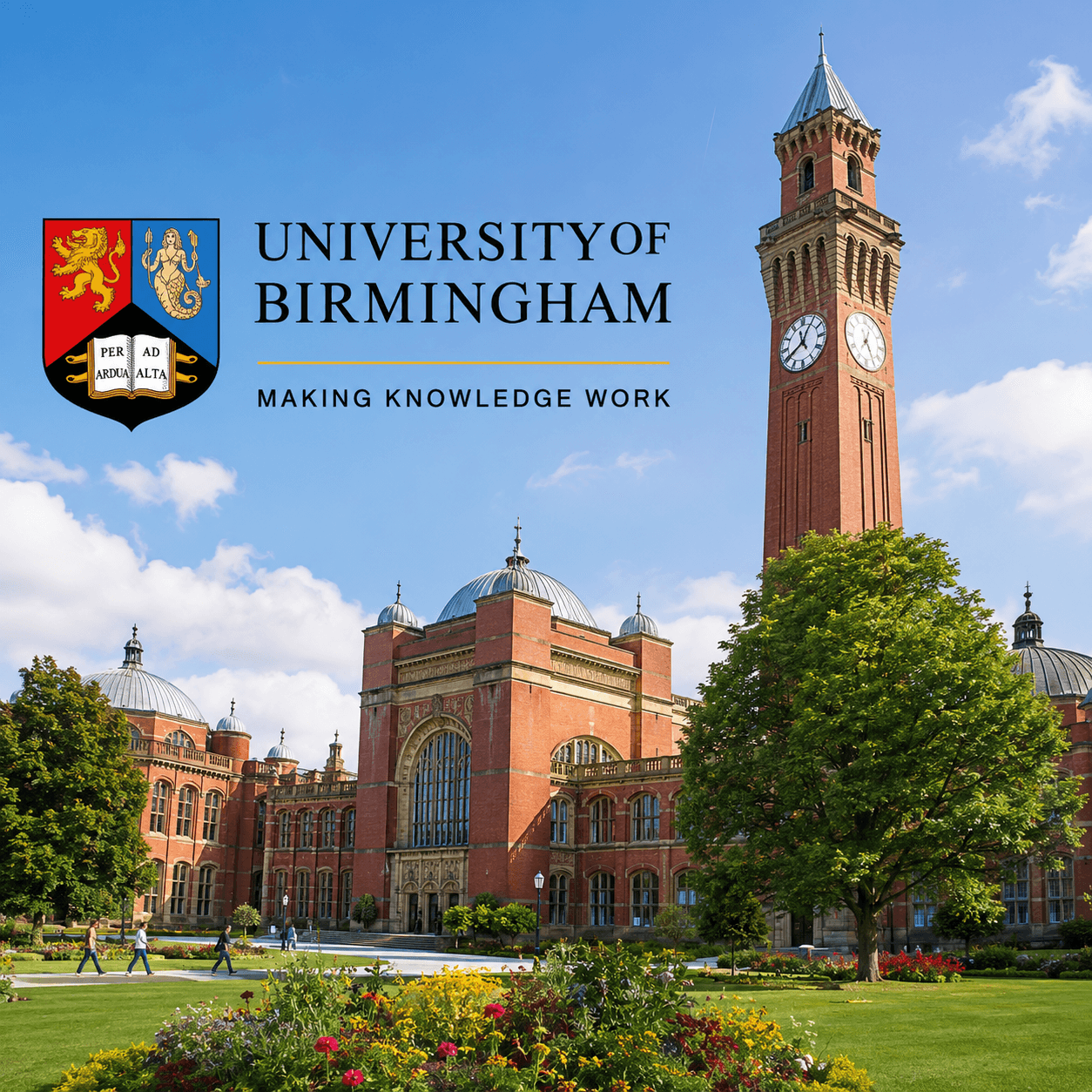
University of Birmingham
Birmingham, England
Cost of Studying in United Kingdom
Avg Tuition
GBP £10,000 – £38,000 per year
Cost of Living
GBP £9,000 – £15,000 per year
Currency
Pound Sterling (GBP, £)
Intake Months
September (Primary), January (Secondary), May (Limited)
Required Exams
IELTS, PTE Academic, TOEFL iBT, Duolingo English Test (accepted by many universities), GRE (for selected Master's programs), GMAT (for some MBA programs)
Popular Courses
Processing Time
3–8 weeks
Visa Fee
GBP £524
Visa Overview
UK Student Visa Overview
The UK Student Visa allows international students to study at eligible universities and education providers in the United Kingdom. It has replaced the former Tier 4 (General) Student Visa and is generally available to students aged 16 or above who have been accepted by a licensed student sponsor.
Key Highlights
Particular | Details |
|---|---|
Visa Type | UK Student Visa |
Who Can Apply | International students aged 16+ |
Main Requirement | Offer from a licensed UK education provider |
CAS | Confirmation of Acceptance for Studies required |
English Requirement | Required, depending on course and circumstances |
Financial Proof | Required in most cases |
Application Fee | £558 |
Healthcare | Immigration Health Surcharge applies |
Application from Outside UK | Up to 6 months before course starts |
Typical Processing Time | Around 3 weeks from outside the UK |
Post-Study Option | Graduate Visa, subject to eligibility |
Eligibility
To apply, students generally need to:
Receive an offer from a licensed student sponsor.
Obtain a CAS (Confirmation of Acceptance for Studies) from the education provider.
Demonstrate sufficient funds for tuition and living expenses where required.
Meet the applicable English-language requirement.
Provide a valid passport or travel document.
Provide additional documents such as a TB test certificate or ATAS certificate, if applicable.
Financial Requirement
Students who need to meet the financial requirement must generally show funds for living costs of:
£1,529 per month for courses in London, for up to 9 months.
£1,171 per month for courses outside London, for up to 9 months.
Tuition-fee funds may also need to be demonstrated depending on the student's circumstances.
Visa Duration
The length of a Student Visa depends mainly on the course duration and level of study. Degree-level students aged 18 or over can generally stay for up to 5 years, subject to the applicable rules.
Work Opportunities
Eligible Student Visa holders may be permitted to work during their studies, with the number of hours and type of work depending on their course and circumstances. Certain types of employment, including professional sport, are prohibited.
After Graduation
Eligible students may apply for a Graduate Visa after successfully completing their course. For applications made on or before 31 December 2026, the Graduate Visa generally lasts 2 years; applications made from 1 January 2027 will generally receive 18 months, while eligible PhD or other doctoral graduates can receive 3 years.
Application Process
Choose a course → Receive university offer → Get CAS → Prepare documents → Apply online → Complete identity/biometric requirements → Receive decision → Get eVisa
Applications from outside the UK can be made up to 6 months before the course start date, and decisions are usually made within 3 weeks.
Note: UK visa rules, fees and financial requirements can change, so students should check the latest requirements on before applying.
Requirements & Documents
UK Student Visa Requirements
To study in the UK, international students generally need a UK Student Visa. The main requirements include:
1. Confirmation of Acceptance for Studies (CAS)
You must have an unconditional offer from a UK university or education provider licensed to sponsor international students. The institution will issue your CAS, which is required for the visa application.
2. Valid Passport
You need a valid passport or travel document for your visa application.
3. Proof of English Language Proficiency
You must demonstrate your English-language ability at the level required for your course. Generally:
Degree level or above: CEFR B2
Below degree level: CEFR B1
Depending on your circumstances, this may be demonstrated through an approved English-language test or other accepted evidence.
4. Financial Proof
You need to show that you can cover your outstanding tuition fees for the first academic year plus living expenses.
Current living-cost requirement:
London: £1,529 per month, up to 9 months
Outside London: £1,171 per month, up to 9 months
The required funds generally need to have been held for 28 consecutive days.
5. Tuberculosis (TB) Test
You may need a TB test certificate, depending on your country of residence and circumstances.
6. ATAS Certificate
Some students applying for certain master's-level or higher courses in sensitive subject areas may need an Academic Technology Approval Scheme (ATAS) certificate.
7. Parental Consent for Students Under 18
If you are 16 or 17, parental or legal guardian consent and proof of relationship may be required.
8. Visa Application
You can normally apply for a Student Visa up to 6 months before your course starts when applying from outside the UK. You must also prove your identity as part of the application process.
Important: UK Student Visa requirements can vary based on your nationality, course, sponsor and individual circumstances. Always check the latest requirements on Student Visa before applying.
Scholarships & Financial Aid
Scholarships & Financial Aid in the United Kingdom
Studying in the United Kingdom is a valuable investment, and there are numerous scholarships and financial aid options available to help international students manage the cost of education. The UK government, universities, charitable organizations, and private institutions offer funding opportunities based on academic merit, financial need, leadership potential, and research excellence. These scholarships can significantly reduce tuition fees and, in some cases, also cover living expenses, travel costs, and other study-related expenses.
UK Government Scholarships
The UK government offers several prestigious scholarship programs for outstanding international students.
Chevening Scholarships
Chevening Scholarships are fully funded awards for students pursuing a one-year Master's degree in the UK. They cover tuition fees, monthly living expenses, travel costs, and other allowances.
Commonwealth Scholarships
These scholarships are available for students from eligible Commonwealth countries pursuing postgraduate studies. Funding may include tuition fees, airfare, and living expenses.
GREAT Scholarships
Offered in partnership with UK universities, GREAT Scholarships provide financial assistance to students from selected countries across various academic disciplines.
Scotland's Saltire Scholarships
These scholarships support international students studying Master's programs at universities in Scotland in selected subject areas.
University Scholarships
Almost every UK university offers scholarships for international students.
Common university-funded scholarships include:
Merit-based scholarships
International Excellence Scholarships
Vice-Chancellor's Scholarships
Academic Achievement Awards
Department-specific scholarships
Alumni Scholarships
Early Payment Discounts
Tuition Fee Waivers
Scholarship amounts vary depending on the institution and program.
Merit-Based Scholarships
Merit scholarships are awarded to students with outstanding academic performance. Universities evaluate applicants based on previous academic records, entrance qualifications, leadership achievements, and extracurricular activities.
These scholarships may provide:
Partial tuition fee reductions
Full tuition fee coverage
Annual financial awards
Need-Based Financial Aid
Some universities and organizations offer financial assistance to students who demonstrate financial need.
Applicants may be required to submit:
Income documents
Bank statements
Sponsorship information
Financial declarations
The availability of need-based funding varies by university.
Research Scholarships
Students applying for research-based Master's or PhD programs may be eligible for research grants and funded studentships.
These awards often cover:
Full tuition fees
Monthly living stipend
Research expenses
Conference participation
Laboratory costs
Research funding is generally available through universities, research councils, and external organizations.
Subject-Specific Scholarships
Many universities provide scholarships for students enrolled in particular fields of study, including:
Engineering
Computer Science
Artificial Intelligence
Business & Management
Law
Medicine
Public Health
Data Science
Environmental Sciences
Education
Eligibility depends on the chosen course and institution.
What Can Scholarships Cover?
Depending on the scholarship, students may receive financial support for:
Full tuition fees
Partial tuition fees
Accommodation costs
Monthly living allowance
Travel expenses
Health-related costs
Books and study materials
Research funding
Graduation expenses
Some scholarships are fully funded, while others provide partial financial assistance.
Eligibility Criteria
Scholarship requirements vary by provider, but commonly include:
Strong academic performance
Admission to a recognized UK university
English language proficiency
Leadership potential
Community involvement
Extracurricular achievements
Personal statement or Statement of Purpose (SOP)
Letters of recommendation (if required)
Some scholarships may also have nationality or subject-specific requirements.
How to Apply?
Students should begin researching scholarship opportunities while applying to universities.
The general application process includes:
Apply for admission to a UK university.
Check available scholarships offered by the university.
Review eligibility requirements carefully.
Complete the scholarship application form.
Submit all required documents before the deadline.
Attend interviews if requested.
Wait for the scholarship decision.
Some university scholarships automatically consider eligible applicants, while others require a separate application.
Part-Time Work Opportunities
International students can also reduce their study expenses by working while studying.
Most Student Visa holders are permitted to:
Work up to 20 hours per week during academic sessions.
Work full-time during official university holidays.
Part-time employment helps students gain valuable work experience while contributing towards their living expenses.
Education Loans
Students who require additional financial support may apply for education loans from banks and financial institutions in their home country. Education loans are commonly used to cover tuition fees, accommodation, travel, insurance, and other educational expenses.
Tips to Increase Scholarship Chances
To improve the likelihood of receiving a scholarship:
Apply as early as possible.
Maintain excellent academic performance.
Prepare a strong Statement of Purpose (SOP).
Highlight leadership, volunteering, and extracurricular achievements.
Obtain quality letters of recommendation.
Apply for multiple scholarships.
Carefully follow all application guidelines and deadlines.
Conclusion
The United Kingdom offers a wide range of scholarships and financial aid options that make studying at its world-renowned universities more affordable for international students. By researching available funding opportunities early, meeting eligibility requirements, and submitting strong applications, students can significantly reduce the cost of their education. Combined with part-time work opportunities and post-study career prospects, scholarships make the UK an attractive destination for students seeking a high-quality international education.
Frequently Asked Questions
Planning to study in United Kingdom?
Talk to our expert counsellors for free, personalised guidance.